England are doing well in The Ashes, so all is well in my sporting world. Not so good if you follow football but since when has it been?
There is something a little miserable about shivering away at 3am watching people in T-shirts likely to suffer heat stroke if they clap too energetically but that is the wonder of modern media.
To compliment my Ashes watching I am reading Crickets Burning Passion. The story of how it all came about. (no it is a proper review not an effort to funnel you to my Amazon affiliate page)
As it is winter here in Blighty my reading matter usually tries to mirror the seasons, so it is polar adventure for me. Walking Home Lynn Schooler. A book I read in one long sitting, always a good sign. Not sure if I stumbled on this book myself or some other outdoor blog had mentioned it. Anyway its worth the read. Middle aged man in crumbling personal relationship discovers time is passing. Thankfully this is no ordinary middle aged desk jockey with a midlife crisis, this fellow lives and breathes the wild and going for a stroll along the Alaskan coast is just what he does.
Perhaps like a lot of people, I spend a lot of time wanting to be somewhere else. Planning for the “next thing” which is usually down a long road and preferably ending with a muddy track. This sort of changed when I read a book listing Britain’s wild places. I happen to live in what is considered one of Britain’s top 50 wild places. Not down the road, not nearby, about 5 minutes gentle stroll.
I have done for years, it is actually inhospitably wild protected by access problems. Low lying saltmarsh that is pretty much useless for anything humans want to do today, unless they want to get stuck in mudholes which do kill you or get caught by rising tides which will drown you. Fortunately you need some sort of boat to really get into trouble, but every year some fools have to be pulled from the mud on the periphery as they have sunk up to their middles. Years ago of course you died, now you get busy on your mobile phone and pray you don’t die.
Its flat, bleak monotonous stuff to my eyes, but the birds love it. So faced with this fact I have decided to expand my knowledge of birds beyond the seagull / duck / goose / wader / sparrow categorisation which has served me well for many a decade.
I am alarmingly ignorant of this stuff. I know more about goretex and stoves made out of cans than I do about the natural world going on around me. I have been putting the cart before the horse for rather too long when it comes to hiking. Sure I have responded to the impressive landscape stuff, the sort of thing you see when overflying an area but I seem to have missed just about everything else of consequence.
Woodland strolls are very much in keeping with my tree identification theme for this year. Currently on my reading list is Richard Mabey, Beechcombings which demonstrates with enough knowledge there is a great deal to be discovered in a wood.
I am not going to assimilate a lifetime of learning in a few hundred pages but at least it will improve on my lifetime of ignorance.
There are an alarming number of tree species in Britain, well over 2000. Most are exotic imports, there are 35 native trees and if I can identify those reliably along with a few imports it will be a pretty good start.
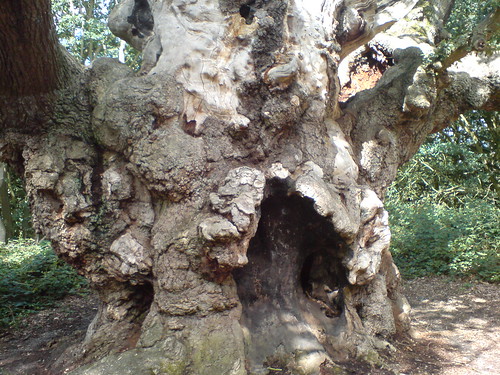
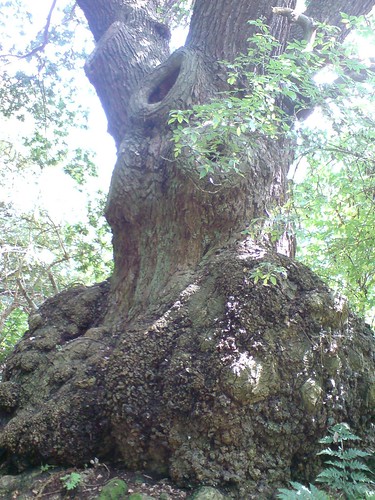
For the last few years I have been vaguely following the Ancient Tree Survey work that has been going on in the UK. Thinking about all those great trees of national interest or local importance I could visit. Then going through the backlog of my local MPs blog, Douglas Carswell, he mentions the plight of Old Knobbley (image).
Old Knobbley is the oldest tree in the area, maybe 800 years old, but certainly old. Turns out the chap needs some help as it is being out competed by trees around it and in some distress, possibly dying. The council got to work to prolong the life of the tree by cutting back some of the trees around it.
Well clearly a visit to the oldest tree in the area before it died is a darn good idea. A look at the Ancient Tree website showed this was not the only noteworthy tree in this small wood. Actually the place was littered with them. I'd guess the highest density of them in the area. Cannot be sure though, its a 3 year project in its early stages and rather reliant on public participation I imagine.
I have walked through the wood previously as an early part of the Essex Way and saw some old trees in passing. This always reminds me to measure a churchyard tree that is not on the Ancient Tree register which as I remember it must be a fair contender.
The 1891 OS map shows an oak grove which was still there in the 1940s maps but no longer exists. The area to the south, The Beech Plantation is still there though.
I put the tree co-ordinates and details into my gps. It would be a shame not to visit each one recorded, although this rather smacks of munro bagging to the exclusion of all other hills. Checklists are of dubious value once walking but purpose is useful, the balance is the trick.
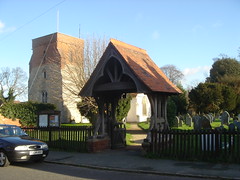
The walk-in begins at Bradfield church, a building with a much repaired tower. The views across the fields to the Stour are inspiring on yet another baking hot day.
The walk goes past church remains. It is reputed the churchyard holds the remains of Matthew Hopkins, self-proclaimed witch-finder. A serial-killer and sadist essentially. It seems fitting any church would fall to the ground whose churchyard contained this poisonous character.
The track takes me past a stile that has no purpose, the fence it took you over no longer exits. Maybe it was a fence, but you can bet it was an ancient field boundary of hedgerow once. It does not sweeten my mood.
A torn leaflet is lying on the ground, I make out the fragments. Furze Hill is being thinned out, dogs to be on leads, dangers, stick to footpaths. The saving grace it starts tomorrow, it could go on for a month.
That is a stroke of luck. The wood is carefully managed and there is no need for significant alarm that the wood is being thinned. I am just glad I can wander without restriction or noise today.
It was thinned last time by nature and the 1987 Great Storm. The wood was planted in 1948, most likely to provide better cover for the secret govt bunker and buildings built around that time. The wood is much older than this. How old and why it exists is not totally clear. The great old trees could be what is left of a country estate.
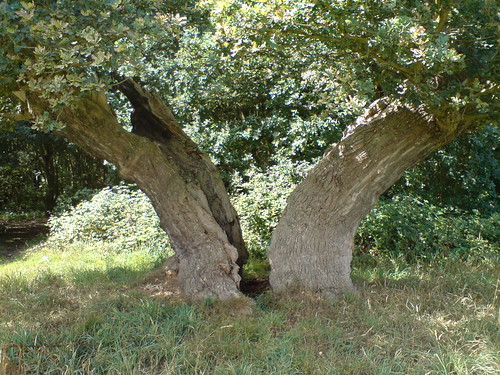
The wood is generous, the old trees are just waiting to be touched and climbed if you wish. One oak has been cleaved in two at some date long forgotten. Almost a comedy cleaving, both halves of the tree lean away like a banana skin peel. Hollowed with age both trunks have a healthy canopy. I walk between the two halves just because I can.
There are many twisted and contorted trees, hollowed from fallen limbs, the remaining tree seemingly effortlessly defying gravity. One oak has massive growths on the base of its trunk. These burrs seem to be like a massive pair of hips.
Old Knobbley is the focus of the walk though, the oldest known tree in Tendring hundred. 600, maybe 800 years old. The area around him recently cleared to help this old timer find resources. He is splendid. I knew what to expect, in the modern age endless images and facts can be gleaned but until I stood in front of the tree I had no real sense of it.
I am not a tactile person but I had to touch the bark of that tree, to share part of the history. It was a tree of age when Matthew Hopkins was killing witches just down the road. The War of the Roses was going on when this tree had reached a maturity.
It is a timescale just on the bounds of my imagination for a living object. There are older trees in Britain but the age of these is beyond easy imagination.
The wood has a large pond at one edge, it was vibrant with birdlife when I strolled along one of its banks. Much youthful cheeping was going on among the water lillies. Trees of all ages, variety and slant were all around me. The woodland floor was sparse of plant life though. I look forward to seeing what the thinning process throws up in future years.
It is not a big wood, but there are so many interesting trees and the walking over the undulations of countryside is great fun. With a little extra knowledge, the helpful guide of the ancient tree study and its resultant shift in my focus, my entire outlook on this wood had changed.
Previously whenever I was here, it was something walked through on a point A to B exercise. This time the wood was the walk and it was great to give it the time for it to tell me a bit about itself.
Ticks are one of those things that are hard to love. Actually they are difficult not to dislike. You are wandering along minding your own business and without you knowing it a tiny hitch-hiker has stuck out a thumb and is coming along for the ride. So far so okay.
Once on-board they can wander about a bit, find somewhere nice warm and moist if possible. So this is the first hint the relationship is not healthy, your armpits and crotch are ideal holiday homes for ticks.
This is bad enough if they just hung about being a vague nuisance, but nope, they bury themselves into you head first, little legs wriggling. The wriggling legs give them away more than anything at this point. The size of a pinhead, not exactly easy to see, especially if via a mirror. There is something unsettling about spotting an insect burrowing into you.
If only this was their least unpleasant aspect. It is bad enough, but worse to come. The reason they are buried head first is because they are after your blood. Leave them long enough they can end up the size of a large pea or more, filled with your blood. They look decidedly ugly at this point.
If only this was an end of it, but in exchange for your blood they can give you rather unpleasant diseases. Lyme's disease being primary, it is not something you want. To add to the fun, symptoms can take a considerable timescale to develop and can be difficult to diagnose. Delightful isn't it.
Removing them as quickly as possible is a good plan. A diseased tick has a greater chance of passing on the disease the longer it is attached. Here the tick has one last little joke for you. Evolution has made sure tick mouthparts are ideal for hanging on. Basically they are not coming out, Pull a tick and its body will part from its mouth. The mouthparts remain in you to go septic. If that is not bad idea enough, in shock the tick probably vomited its stomach contents into you. Not great for disease avoidance. Burning them, covering them in meths etc etc have similar drawbacks.
So removing a tick fast and efficiently is a good plan. The best way I have found is with a tick removal tool and daily inspections where at all possible.
Not all removal tools are created equal. After failed experiments with a few (it is useful to have a small dog as a tick collecting device) I found the O'Tom Tick Twister to not only have the most flamboyant name but also the best results.
The device is simple, effective, efficient and small. Seems to have some eco-friendly credentials too boot. The Vetinary Record tested 4 different extraction tools offering different approaches to the same problem and the O'Tom was significantly better than other methods.
This is one bit of wildlife I am keen not to meet on Dartmoor. I fully expect to be pulling them out of the dog at some point though.
Selling Nature by the Pound. (with a nod to Genesis the rock group).
Seems Department for Environment, Food and Rural Affairs budget is being cut by 40%.
So much for the “green govt” credentials, presumably they meant forcing windfarms into existence.
It looks like they are keen to sell greenery off as fast as possible. This really is not what the people voted for.
Harold Macmillan accused Thatcher of selling of the family silver, that gone it looks like the next phase is to sell off the estate.
Privatisation of parts of the Forestry Commission. Selling off National Nature Reserves and withdrawing grants from British Waterways.
Words sort of fail when faced with this sort of news.
Once again the govt has gone for the soft target.
I finally got around to watching a program I recorded in Feb this year. Robert MacFarlane was sort of doing a TV version of his book, The Wild Places. (youtube link to the program, 6 parts)
Sort of.
He was focusing in on one county to prove the point “wildness” is everywhere (well anywhere there are not a lot of people)
The county in question, Essex. MacFarlane speaks of Roger Deakin opening his eyes to the concept of wild. Or at least to appreciate a weed growing from a crack in the pavement has the elements of wild.
I am not really prepared to visit a toxic landscape by an oil refinery to be impressed by lichen on a grey wall even with MacFarlane egging me on. He does accept it is a wildness which makes you work pretty hard to appreciate it.
Hmmmm, well pupil is not ready to be master, so I am giving it a miss.
But in another segment MacFarlane is waterborne in an old wooden canoe willed to him by Roger Deakin. He is in Walton backwaters where there is a colony of grey seals. This looks to have more traditional elements of wild. Another book about wild places in Britain gives the backwaters high praise putting it in the top 50 or so places harbouring wildness.
I am cutting it fine for a trip to the coast, this is primetime seaside holiday period. Fine if you are a fat drunk conversing with your kids as if they are in another county via subtle variations in the F-word, not so great if you walk upright. Nothing ventured, nothing gained and Mr MacFarlane seemed to be having a very pleasant secluded time communing with seals.
The backwaters could be found behind a large grey shed of a building, The Columbine centre, built on a flood plain 200 yards behind a sea wall, its the local swimming pool, cinema, indoor bowling club, theatre, car park, eyesore, built in the municipal mundane style.
Behind it, beyond the overflow carpark, is a large earth embankment and once I got to the top of that, I was greeted by a small sewage works, some stinking mud and static caravans.
The stinking mud is what I had come to see it transpires. Given I saw MacFarlane gracefully paddling over limpid waters gazing at basking seals I was glad I did not take the oil refinery option. Gawd alone knows what mouth of Hades that actually is.
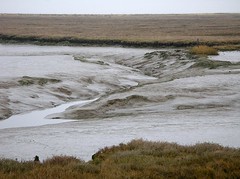
Oh well, I am here now. I walk along the top of the sea defence bank. Boats are languishing in the mud, the tide is out. Some boats look as if an incoming tide washes over them rather than float them. Neglect is the impression, this could be a tough sell.
The Twizzle snakes off to do its thing, whatever that might be. In fact the whole low lying area is snaked with water, my walk is taking my along the Walton Channel up towards nowhere much.
Once I am past the caravan site. which was not bad, just unexpected, things pick up. Flat and essentially treeless would be an uncharitable impression Across the farmers field, golden with crop, is a headland and a navigational tower. The tower is a focus of a lot of ineffective hand wringing. Coastal erosion is eating the cliff at quite the rate. Earlier versions of the town have slipped into the sea over the centuries.
It is a landmark tower, ancient and unique, maybe that will be the reason they get the sea defences they need. Probably not is my guess, there are a lot more things to throw money at than a social security hotspot.
The view is impressive, golden crops, green hill, deep blue sea water, a large ferry going into Harwich, a larger container ship going into Felixstowe. Bold colours for bold ventures.
The farmland is protected from the higher tides in the backwaters by an earth embankment which is strengthened on the seaward side by small concrete blocks, much overgrown. The bank is in excess of 12 foot I guess and there is quite a large drainage ditch which runs around the farmland, I guess that is where the soil came from. On top of the embankment is a low wall made of concrete slabs, much weathered and failing in a number of places. Perhaps this was put up after the 1953 flooding of the area. It is either carefully worked out or just something slapped on the top as an after thought. It looks very after thought right now.
Among the flotsam I spot a jam jar, it has paper contents. A message in a bottle, so more akin to jetsum. I go over the knee high wall on the top of the embankment, noticing it had yellow lichen on it. Within the bottle is the block capitals of phone number. Its from the far off shore of Dovercourt, maybe 2 miles away.
Still it might have age on its side if not mileage. I will contact him and he will remember wistfully the far off days when he had teeth and had thrown this jar into the sea.
The lid of the jam jar said, best before 2011.
Oh well, I bunged it into the mud where the next tide would set it on its travels, purposeful litter, sort of. I make penance by picking up the nearest 3 plastic sports drink bottles.
I notice a large blue tarpalin draped over the wall, could not miss it. Also a blue sleeping bag. Looks like someone has been wild camping and left in some haste. Bright blue is not the fugitive colour in this landscape, unless his quick exit was via police escort. Still I gather 7m of paracord and a tin of baccy. I want the tin, I could buy one for no money, but its got no memory, this one is better. My guess, rain stopped play and they headed back to whatever caravan they were meant to be in, suffering the banter of his mates/family, a future Ray Mears returning to mere mortal.
A beautiful Red Admiral sits on the low concrete wall. It is the butterfly all of its species should be judged by. The brightest of colours, it really is striking, but it is a shy beauty and refuses to be photographed. It will grow impossibly perfect in my memory, and why not. The baccy tin, gathers another association instantly.
Bird life is noisy and greedy, all manner of things are wheeling overhead and poking about in the mud. Specialist stuff by the looks of their beaks and all impressively clean. This looks like the sort of mud you dump bodies in. You would have to be daft to go out on it. Needless to say the coastguard cheats Darwin every so often and saves someone from the mud.
Moving along I see a duck boat lying in one of the many folds of the coastline, it is drapped in weed, unloved the tide must flow over it. Long low and built with purpose it seems a shame to be allowed just to rot into nothing. It has resisted the sea for quite some time for that much weed to have accumulated. It is part of a past we don't need now, but one day we will wish we had not been so neglectful of such things.
I look out over the grey mud with some grey sea running between it. No grey seals, but it is early yet and I've not got my eye in.
In part two, will I see a seal or will it just be a blubber stomached tourist floundering in the mud.
Was reading about the big butterfly count for this year and was reminded I had a bit of butterfly hunting left over from last year.
The White Admiral is found in very few sites in Essex, until the mid-90s it was reputedly only to be found in one. This was where I was heading, Stour Wood. It is near the River Stour of couse, but not as close as Copperas Wood, which is close by.
Copperas Wood is worth a mention as the treeline goes right down to saltmarsh. I believe this is the only such instance in Essex. This is prime bird watching territory, which I guess will be on my list of things to know more about. (image of the destruction)
Back to the butterfly.
I have left it a bit late for seeing the white admiral, mid-June into July is primetime. Given the alternative was waiting till next year it seemed worth the effort.
The White Admiral is not a rare butterfly but numbers are declining and its a high priority for butterfly conservation. Spotting one in a rare location is more fun than spotting them where they comparatively abound.
Also breaking in a new pair of boots, so tree gazing and butterfly spotting seem suitable activities. Modern boots don't need the sort of breaking in period of old but it is still a good idea to not destroy your feet as they get used to boots.
Driving down I spotted a cherry tree with a lot of fruit laying underneath it. I made a mental note to visit my favourite cherry picking haunts.
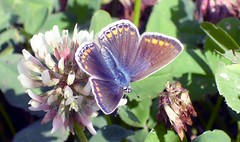
Before I actually got to the wood, I stumbled on a small meadow which seemed to be filled with Holly Blue butterflies. So many one hung around obligingly to be photographed. Maybe they had just hatched out into the sunshine and getting their bearings. I marked it as a good omen.
The walk begins at Ramsey. There is a carpark at Stour Wood but the walking in is part of the deal.
Ramsey windmill blades loom from behind a bush which would never have existed when it was working. The mill has not ground flour for a long time, but it still looks out over the fields whose crops it must have once milled.
The windmill was moved from its original location in Woodbridge to its new location in 1842. A working mill till World War Two, it fell into dis-use and was saved by volunteers in 1974 at which point it was a collapsing derelict.
The signpost pointing out the long distance footpath, The Essex Way sported a new style of flash for the walk. Good to see if it represents an overall maintenance program of the walk but I cannot help thinking replacing everlasting plastic flashes is a regular waste.
Going off The Essex Way, heading west, the impressive chimneys of Roydon Hall come into view. It is marked in gothic script on the OS, non-roman. What stands there now is a late 16th century building but the site goes further back than that. It stands in isolation.
Onwards to Stour Wood which covers over 130 acres and is actively managed, it was coppiced until the 1970's and is being done so again. It enters the written record as being coppiced in the mid-1600s. As with all things there are people willing to say the Sweet Chestnuts date all the way back to their introduction by the Romans.
The fact the wood is named after the river rather than a landowner suggests age and sweet woodruff along with other plant indicators underline this. There do not seem to be trees of any massive age within it that I am aware of though, although coppice is not giving away its age easily..
There are a good many well defined footpaths through the wood along with many rather more ad-hoc looking affairs. The northern edge of the wood is bounded by the railway line which runs on an embankment at near canopy height. Very odd to hear a train go past high above your head. The river is a little beyond that.
On my walk I was pleased to see one of the few surviving small leaf limes which remain in the wood. Squirrels were having a field day among the Hazel trees. I eye the hazelnuts hoping a few will be left for me when they are ready.
One tree on the edge of the wood was bursting with activity and remained so when I went back to it a couple of hours later. The birdsong gave the hint and then i saw them silhouetted, tiny little birds smaller than the leaves with the distinctive long tail, the long tailed tit.
Good too see them, not rare, but I rarely see them because they are so damn small. These birds made it into the top 10 garden birds in 2009 but chilly winters can kill 90%, it was a cold winter, they did not make the top 10 in 2010.
Many trees lay where they had fallen in the great storm of 1987, shooting up new growth from their horizontal rest. In nearby Copperas Wood 25 of the 34 acres were flattened that night. It was a shocking destruction I remember well. Trees are not easily destroyed though as evidenced from the coppiced hornbeam sprouting from stumps cut to within a few inches from the ground. Apparently regularly coppicing gives a tree an almost limitless lifespan. This is not a wood tidied to within an inch of sterility, dead trees exist, lots gets to live in it.
Humanity was present in the wood but huddled around the car park for the most part, noisy. Within the wood it was easy enough to forget the world outside.
Butterflies were not exactly in abundance, I saw very few and was giving up hope of spotting the White Admiral when sitting in splendid isolation I saw exactly what I sort. Sure it was a bit ragged and somewhat dull but it was The White Admiral and I was very pleased to see it. I wondered if I might see another having seen one but I did not.
I explored happily for a few more hours and took a circular route back following The Essex Way back out to my start point, it leads me out of Stour Wood along the banks of the river itself and into Copperas Wood. The bushes along the riverbank had many sloes in them, testament to how vile they are to it. Some blackberries looked edible but barely were.
Copperas Wood had a last little surprise for me with a litter of small crab apples just as I was leaving it. They looked the very definition of bitter.
On walking back to the car at Ramsey unaccompanied singing was coming from the spartan Weslyn chapel by the footpath. Quite a congregation, it sounded tuneless and heartfelt and put a smile on my face, it was good to hear. The end of a pleasant five or six hours.
Seems the boffins have been busy when it comes to Scottish midges, but I guess it applies to all nationalities.
Midges are more likely to bite tall men and fat women. 15% of the people appear to produce a natural insect repellent and this has a hereditary aspect. Oddly fat men are just as likely to be at higher risk to midge bites, but there were not enough male fatties signing up to the study for it to be provable.
Carbon di-oxide and lactic acid are midge attractors and it seems fat people are producing more of it. If you want to suffer fewer bites then your body better start producing geranylacetone and methylheptenone.
Mixed in the right quantities this is a great repellent. Already efforts to manufacture it are under way and should be on sale in Asia shortly. Within a couple of years it is expected to be available in Europe.
The old standby of Deet has a few drawbacks, one of them being 60 percent of mosquitoes can become immune to it.
And just for a bit of cheer peak midge season in Scotland is June to Sept and a hectare of land can contain 25million biting midges.
I am not clear if standing next to a tall heavy breathing sweaty fatty would mean less bites for me, or if the insects would be in such a frenzy anything near them would be dinner as well.
I park badly in the main street which is Nayland. I regret this almost instantly when a large double decker bus hoves into view and makes hardwork of navigating the narrow main road with cars parked randomly on either side. Regret it, but do nothing about it, I could have tried to cram the car 4 inches closer to the curb but I will take my chances. Odds are I will scrape the tyre walls and bust the hubcaps on old fashioned high curbs. It only represents a problem to the reckless, they will slow down to a legal limit or hit it.
A recent very expensive redevelopment of my local village saw the removal of fine old high curbs. All old curbstones come from Dartmoor in my imagination and so the removal of them breaks an imaginary link with my favourite locale. .
The old town planners knew what they were doing though as everytime it rains now the shops on one side all flood as water pours over the new low profile curbs. The developers have trousered the EU grant and are long gone, tearing up someone else's high street having pulled the wool over the local council eyes, or more likely crossed their palms with silver. Now the few pedestrians that did care if they were in the road or on the pavement are no longer sure. Be dangerous if the road system was able to allow people to do the legal speed limit but a gridlocked crawl between expensive and pointless traffic lights is all that is allowed..
Dogs and I have to cross the Roman Road which is now a multi-lane A road. On the other side sits a large converted barn, now some swish commerical enterprise. Traffic was light, we were soon across, that makes a pleasant change.
This bit of the walk starts with a new wooden kissing gate, a renewal and promise of a future. It is good too see things are cared about. A bit of string marginally too short is used to fasten the gate. It makes securing it difficult, but the last person through had made the effort. It is a good start.
An electric fence seperates the walker from the empty field. This was actually a theme of the walk, a lot of low cost fencing, electrified, or barbed wire. The dogs were off the leads and free to wander. Sometimes they might get more than 12 feet from me, but its rare and not encouraged. They are not strangers to leads, nor are they slaves.
Almost instantly I met an elderly woman with a young outlook walking a young dog who was as old as the hills. The dogs name was Reggie. We soon put rural England in it's place (high), "Nowhere else like in on Earth, look a the wind blowing in the willows". I did as told and was rewarded by seeing a little bit of the world as this lady saw it.
Having agreed on it really being a green and pleasant land we chat as dog owners do. I am not sure what the dogs are saying, but it involves a lot of arse sniffing. The walk is going to cover 16km and within the first 50 yards I will have seen 33% of the humanity I am going too. I get about 3 words out of the other 67%.
It never ceases to amaze just how few people you bump into once more than 400 yards from a road. I met none on a beautiful weekend on footpaths linking Suffolk villages.
Oddly the conversation with the woman had turned to religion. While the dragon tale and the OS map were the starting point, the wonderful Ronald Blythe was the living spirit of the landscape for me. Born 1922, a man whose faith is meaningful and informed. He has written many a book about where I walk because it is where he has spent a lifetime walking. His book Word from Wormingford is in my bag as I stroll.
Mr Blythe is the companion in my head as we walk. He has walked every step I will walk, many times.
Dogs and I left to our own devices, we are surrounded by the noises of industrious nature going about its business. Streaks of blue, long sleek elongated bodies zoom by. They look faster than they are, the common blue damselfly, well named. Water is nearby.
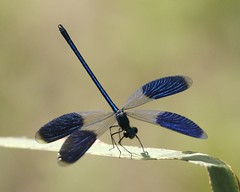
Then a gathering of banded demoiselle flap around us almost impossibly fragile, how do they manage?
Butterflies are in profusion enjoying blackberry bushes by the look of it. Red Admirals are putting on quite a show, my favourite from childhood. The Painted lady, last years wonder, are not to be seen. I cannot help but miss them.
The first glimpse of the slow moving River Stour through trees. I take a well used track to the waters edge. Willow dips low and trails in the water, it literally brings the landscape to life. Water is also magical for the caveman ancestor within us all. Every cell in our body knows it needs water, it is a basic joy.
The River Stour runs in the valley, which is to say this landscape is not flat. It is surprisingly lumpy, in places positively corrugated. The views across this wide valley are fabulous. Winding my way through a field of ripening wheat I can look across a patchwork of fields and associated buildings. Although harvesting has started in my neck of the woods it seems not to have begun here yet.
The church tower at Nayland, is in plain view and will be even when I reach the turning point of the walk in 5 miles time. The church towers remain the tallest buildings in the landscape, commerce does not loom over faith here.
At Wissington, which according to a text is called Wiston by the locals showing a preference to its ancient name, I bump into my first moat as well as small Norman church.
Essex and Suffolk are the English counties with the most moats. Hundreds of them each. Until I read Roger Deakin, Waterlog, my idea of a moat was the thing around a castle. Not so. It became quite the status symbol and would appear around farmsteads or simply barns. They need not be defensive as a good many did not encircle the property. They fulfilled a variety of functions. If you are interested here is a link to Channel 4s Time Team mini site about moats
In the mid-1600’s a number of families left Wissington and took their Puritan beliefs to the New World and the Massachusetts Bay Colony.
Religion seems alive in the landscape. I have remained immune to any organised religion but rather like malaria, just coz I don't have it, doesn't mean it doesn't exist.
My path turns towards Little Horkesley but turns off before I reach this interesting little village. Another day for that. I am heading towards Bottengoms. We walk through a plantation of widely spaced but obviously regimented willow trees, some marked, presumably for felling. Others are saplings just beginning their journey.
In my mind all willow trees are destined to be cricket bats, it's a noble calling. So I don't know enough about willow trees, this much is clear..
Bottengoms is a house nestled in the surrounding countryside. So nestled its near invisible, hidden by the rolling landscape. Horses are in paddocks nearby as I look down upon it.
Bottengoms is ancient and I believe still without mains water. It was the home of John Nash from the late 1920's, the artist of international reputation. Now it is the home of Ronald Blythe having been bequeathed it on the death of his friend Nash in 1977. So I walk the land Mr Nash new so well and painted so wonderfully. I walk the land Mr Blythe writes about so lovingly.
I wonder what the war artist Nash would have made of the barbed wire which encloses fields nearby and hereabouts. My guess, not much.
What an enchanted spot, a nice place to stay for a while.
Part 3 coming soon enough.
A small mystery was resolved today, but it opened up the door to another, greater mystery.
A few months ago I was strolling down to where I was working that day. A stretch of Essex coastline. A warm morning, the skies were clear, it was going to be glorious.
Out of the corner of my eye I saw movement and then scurrying in front of me was a bright green lizard, mottled with brown. He was in too much of a hurry to pose for a photo and I was to enchanted to care. He seemed to be maybe 12cm long. I had never seen anything like him. As delightful as he was unexpected. It brightened my day.
Getting home and hitting the reference books did me no good, a search of the internet came up with nothing that really looked like what I had seen.
The incident was put to the back of a cluttered mind.
I get in from work today and Alan Titchmarsh is boring on about UK wildlife in his rent-a-presenter manner. I am not a fan, but his demise by remote control was stopped by the fact he mentioned being in Devon, or Dorset. Where-ever it was, somewhere I would rather be..
Next moment the lizard I had seen was on-screen. A sand lizard, endangered, they live in colonies.
The interesting thing being the nearest known colony (there are 580 recorded in Britain) is about 80 miles from where I saw one.
The internet is a collection of small wonder. A quick search and I found the chap I wanted to email to tell him. The UK co-coordinator of sand lizard counting.
Turns out you need a licence to count these thing. Seems a bit of fuss, but doubt I have broken to many laws by having one run in front of me. If it does get legal I suppose I can fall back on the defence there was only 1, so not really any counting involved.
All joking aside I am actually more excited by this brush with endangered species in a place not apparently previously recorded than I expected to be. Not that I had given such circumstances all that much thought..
I was pleased to get it identified and thrilled it might represent an increase in numbers for an endangered UK lizard. The chances of seeing it again, given the area I saw it is remote.
My only regret is I did not get a photo, but at the time i had no idea it was an exciting rarity which would be of significance to anyone else.
Taking a leaf from Proust this was a day which involved seeing with new eyes rather than seeking new landscapes.
Too darn hot for wasting effort, a day for conserving reserves. Too nice to remain indoors, however attractive the shade, it is the shade of brick walls.
To the allotment, the wild made tame, although probably somewhat wilder than others entirely appreciate. Thankfully it is the most wonderful secluded spot, tree lined and in places overgrown with lovely blackberry bushes. To large for most people to want to cultivate, defeating their horticultural imagination.
What the late frosts did not kill the rabbits have eaten and what they found inedible the lack of rain has withered. It is not a place of self-sufficiency but nor is it a temple of neuroisis, a chemical attack on all that is nature. The stuff is given the best chance of growing with the understanding Tesco provides it cheaper.
So on the basis I don't need the food I grow there as much as the wildlife does, they end up eating most of it.
The pond is overgrown, offering welcome shade to the fish i can see below the surface and the odd pair of frogs eyes breaking the surface. The whole area is teeming with frogs but they have more sense than to break cover. The other week when clearing the pond a newt was collected up. The pond in dimension is only a generous bath-tub but it is home to so much life and activity it is barely credible.
I find a shady spot to settle myself, the earth is baked and is radiating heat. The grey soil is uncomfortably hot to hold in my hand. The china blue sky has no clouds nor contrails, a real rarity.
Sometimes such skies seem close enough to touch, fragile enough to crack with a hammer. Not today though, it looks a long way away and has the depth of deep water, a sky you could fall into. I lay down, book reading was the chosen activity.
Plants are sucking up moisture from somewhere, there is a lot of growth and bees are busy. Hives are close by, liquid sunshine stored up for me. This surely is the season of flight, everything seems to be a buzz. Flies are going about their business, some land on my sweating hands. I don't know much about flies but I expect sweating hands are quite a treat so leave them be.
Behind me is quite a commotion. I am sharing a territory with a blackbird. If she minds she is not showing it as she scrabbles about the undergrowth for worms and grubs. I expect she hopes I will be turning the soil for her, but it is too hot for that. I am there 3 hours and we co-exist happily.
I cannot say the same of the wood pigeons. They were happy enough with my company but the boisterous wing-clapping and calling seemed more than was totally necessary. The barking from branches above my head meant the squirrel had accepted my presence enough to make a fus about it. He preened and cleaned himself between scampering branch to branch.
All was well with the world, although no doubts endless life and death struggles went on around me as I lazily read the pages of my book. A book about songlines and dreamtime in the fierce Australian heat. It seemed suitable as the sweat rolled down my still forearms.
Within moments of taking off my shoes and socks i could feel the sun working its heat into my feet. Had to be careful with them, they are very un-used to freedom and the idea of sunburnt feet does not appeal.
Over the years my family have sown and grown on this bit of land, as have nameless others for the 100 years this land has been allotment. Much has been developed around it and older maps show lost allotments as housing has encroached.
All in all a perfect little adventure on a small bit of land I know very well. The aborigines have a concept about the depth of land, that which is underneath. Today I added a little more depth to this bit of land and made myself part of its story.
Last year it was collecting images of butterflies which gave my wanderings a continuity thread. There is no reason to give up on this venture but the learning process it affords is becoming increasingly marginal.
Hopefully there will be species this year I did not see last year but the majority of the identification will have been done. For some reason I missed seeing the Orange Tip butterfly last year, something I rectified this year. Yet to take a photograph of these rascals as they seem to have plenty of energy to burn and landing seemed to be on none of their minds.
I like trees, the more the merrier (commercial conifer plantations excluded) but my knowledge of them is suspiciously scant. I have secretly envied those that appear to be able to pick up a twig and tell what tree it is.
So this is the project which will inform the next few months stroll, leaves being a pretty good hint as to what the tree is. Trees are patient creatures not prone to flying away before identified and when i go back next year they should be where I left them.
The downside being there are a lot more species I will commonly encounter and for the most part they are going to be brown trunks supporting lots of green leaves.
I have the hide of a rhino, the concept of bruising is alien to me. Biting insects avoid me for more suitable fayre, perhaps the nearest house brick.
Imagine my surprise when a rash appeared on both my legs below the knee recently. At first this was of no particular concern, I don’t get rashes so this was not a rash.
Itch, itch itch, followed by moments of relief as I scratched, followed by more itching, scratching, followed by raw patches, followed quickly by bleeding. Time to admit it, evolution had caught up with me and I was dinner for some insect.
I was totally unprepared physically or emotionally for such an assault. It is not so problematic that I have actually done anything about it other than curse but most certainly vegetation over ankle height is now looked upon with new found respect.
And there is a lot of vegetation currently which fits that description and I spend a good deal of my time involved in it. We are enjoying a prolonged hotspell in the SE bit of England after rather a late start. This seems to have compressed the growing/hatching season somewhat and everything is making up for lost time.
The most likely culprit for my rash is a caterpillar which is covered in hairs which are a considerable irritant to many a person. Never had any problems with them before but this year they appear to be about in rather higher numbers. In one area I counted over a dozen of them within a 1 metre square of where I stood. I was not even making a study of them, they were just there in plain sight.
This is a report about the type of thing from a newspaper report last year. While the more alarmist reports would have us all in NBC suits I have to admit its damn annoying if a weakness has been discovered in my constitution.
Last year a gnarled twisted old tree was in full blossom. The last tree standing before the land gave way to sea, its stunted growth had been much influenced by the continual and usually pretty tree unfriendly environment.
Add to this it was near a play area, such as they are now, and a road, the tree represents a determination to survive. It’s existence enhanced the area.
I don’t now how many times I would have carelessly passed that tree giving it but the slightest thought but this day the sun was behind it just right. The fact it retained its blossom was the reason, usually the sea wind would remove it almost the moment it appeared. I had no camera so resolved to return to get the picture.
Of course life seems to be composed of more important things than making a special trip in the hope of catching a tree in full blossom, with the sun behind it. But I owed that tree a photo.
I promptly forgot until last week when I went past again. The tree is a stump a few inches above the ground. The council cut it down. I really really hope it has nothing to do with the failed flats development sitting across the road. Sea views are worth more than tree views afterall and there is a surprising correlation between a new house going up and an old tree coming down.
I will go back and count the tree rings to get an idea of how long it was there.
My chance to photograph this tree, that will have struggled almost everyday of its existence was gone. I don’t know how long that tree had stood there, but gone is gone, there will not be another there in my lifetime.
It is filed away in my minds eye along with other trees in the area I have admired and which no longer stand. It is a considerable number, and while there are many left, there are fewer, each one is a loss.
I missed my chance to capture something which will not return and I regret it. You never know what tomorrow will bring, if you have something to tell someone say it, if you have something to do, do it. It is not always practical of course and I will fail to follow my advice, but if I try a little harder to do so, I will miss less.
The weather broke clear and it was time to go to the woods. Nov 5th, bonfire night in the UK and that means roasted chestnuts.
Roasted chestnuts of course means a trip to my favourite wood in the area and the sweet chestnut trees contained within. Some recent winds will ensure there are plenty on the ground to be collected. Last year was disappointing, not sure this is going to be much better, but live in hope and accept what you get. It is a very quiet wood, very rarely see anyone else there so hopefully the wildlife will not mind me taking a pocket full of chestnuts to commemorate the day.
The eldest dog is off to the vets as well today so there is an additional reason for going. The “just in case” reason. He has developed a nasty barking cough, it has the sound of windpipe issues in a breed known for windpipe collapse. He is also rather old now.
There is a slim chance he does not come back from the vets. There is a higher probability the days of anything more strenuous than a romp around the garden is going to be curtailed. So for all these reasons it was time for a walk.
The recent rain has made the ground underfoot “claggy” and standing water was in evidence when I got out of the car. Nothing too concerning although my trainers are being pushed to comfortable limits by the mud. The farmer has ploughed up the footpath along with his field. The path is marked well enough at either end on the landscape and better etched in my mind. A simple matter of stomping out a new path. It felt good to be breaking in the path for the season.
Two of the dogs were breaking in their own paths, the youngest stuck by my heels. Brains beyond his years as the other two fools kept half an eye on me as they meandered about on their chosen routes.
The lack of path is only temporary, there is always a well defined path through the farmers crop, no complaints there.
Ahead of me a rich canopy of trees, more than I expected in green leaf. Getting under the canopy and the relatively hard ground will be nice after clod-hopping. All around is stillness, there is not even wind enough to stir the leaves.
The footpath always leads me to the exact same spot in the wood, there is a clear boundary between wood and farmland. The same view greets me each time I enter the wood but every time it is different.
For years I have tried to square a circle. Should I continue to return to places I know and love or go and experience new places and perhaps love them. What makes this wood better than other woods and if I do not visit other woods am I missing out on something?
This usually comes about when planning an extended trip and more often than not my beloved Dartmoor is the place I end up. There is always the nagging feeling I am missing out on a “new” experience by just going back to Dartmoor.
Today with my old dog and his two younger companions I realise it is not the place it is the memory. This wood is a favourite because I know it and it is always showing me something different. My experience and memory of this place has growth rings as surely as the trees. It is the same with Dartmoor, it can always show me something new and add to my knowledge of the place.
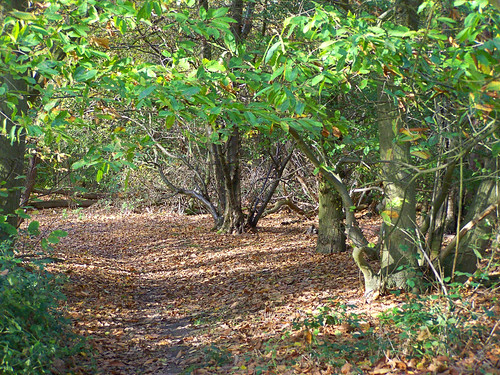
Today it is autumnal leaves dusting the path, in the spring it was a carpet of bluebells. In the summer the ferns grew and you could barely see the path and much was hidden from view.
The trees that blew down in the late 1980’s lie, living where they have been lying for 20 years. I remember them vertical, the shock of seeing them blown down can still be conjured up without difficulty.
There are many beautiful places I would love to see, but I am not going too. They would be brief experiences, treasured no doubt, but with no great depth to them, not like this little wood I know so well.
Today as I went through the wood deciding which bit of fallen branch would be suitable for a ceremonial burning on the greater bonfire of Nov 5th another fellow with a couple of dogs came into view.
I had selected my two foot long bit of branch, wet through, I was imagining the sparking and cracking it would do when put into the flames, certainly very suitable for bonfire night. A number had failed scrutiny for any number of “not quite right” reasons.
The two groups of dogs circled each other determining if this was fight or friendship and the man and I pretty much did the same in a more subtle manner.
There were the positive elements, a dog walker in a wood that takes a bit of getting too. From his point of view though I have just picked up a stout looking branch, that cannot be so good. He looks down at it.
“A branch from my favourite wood to burn on the fire tonight” I say. You can feel the tension leave the scene.
“You from around here?” he asks.
This tends to mean how many generations are planted in the local graveyard. Anything less than three means your an “in-comer”, although this has changed a lot recently as the towns spill out, imagining themselves to be in the “country” as long as they can turn it into a townscape as fast as possible.
“Family been here long enough to see plenty of changes for the worse”.
The chap nods his head, yep we are on the same wavelength. We have a pleasant chat, two blokes in a wood with 5 small dogs. He has been coming to the wood for 40 years, he has the edge on me. Remembers a time when people regularly visited the place, now he was surprised to see me. Just as surprised as I was too see him.
Autumn was his favourite season in the wood, although he liked them all. He liked it more than spring. I could understand his reasoning, but it is going to take some thinking about to decide if I am in agreement. There is a lot to consider.
I knew I had been accepted as a kindred spirit when the fellow said how wonderful the autumn colours had been and what great photographs he had got when he had been out with the local hunt.
Hunting is one of those flashpoints, you don’t mention it unless you want an argument or know your on pretty solid ground. Countryfolk hunt, townies don’t. If you are a countryman against hunting, then you only think you are a countryman is pretty much how the logic runs. That or you don’t have enough generations in the local church.
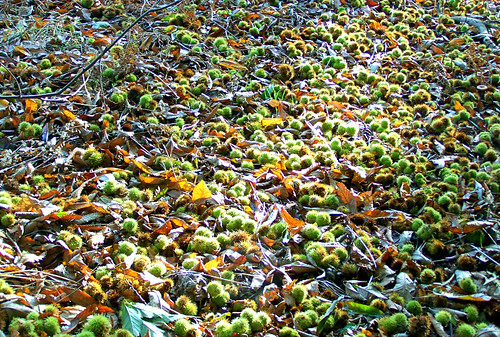
It was nice to meet the man and another memory ring has been grown in the wood. I wandered about happily, collecting a few sweet chestnuts and taking some photographs. There were places where the ground was heavily strewn with chestnuts in their prickly outer casings. Walking through was very slow as the dogs picked their way along very gingerly.
Water was running in the little stream that goes from one end of the wood to the other. The first time this year I have seen the water running in it and it was good to see. A lot of the year has been very dry despite the rain, which makes the sort of sense these things do when you experience them.
It was time to turn back and go home, a vets visit is looming over us. I expect to be returning with the old dog but there is never any harm in getting another walk under his collar. His sister used to walk with him when he was a puppy. She has been dead two years but I am sure she still walks with him in this wood.
Footnote: I waited to post this as I did not want anyone wondering the fate of the old dog. He returned from the vets and has some pills which may help him. Bottom line, he is an old dog, but as fit as can be expected.
Photography is a significant part of my strolling. It acts as a record of change and a jogger of memory. I take a great many simple snaps, hundreds adding up to perhaps two thousand a month. It is fairly mind-bending just keeping the catalogue of the images so they can be searched and sorted in some fashion.
I am a hoarder of memories.
Every so often from the painfully mundane an image that can illustrate a point on the blog can be culled. A good many photographs just go onto my flickr account, a slideshow runs on the left hand side of the blog if you are interested in seeing the photostream.
As with everything else I hope to be on an upward learning curve when it comes to photography but it is debateable. I spend a lot of time enjoying other people’s snaps, some of the work is breathtaking. They are all inspirations.
Here are some of the images which mean something to me in August.
The month itself is far to short in the way that February is much too long. Winters might be milder, spring might be arriving earlier, but none of this has yet to save us from the misery which is Feb. The two months August and February are calendar opposites but somehow February always seems closer to hand than August.
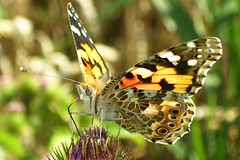
The most dramatic early feature of the month were butterflies. It has been well recorded this was the year for the Painted Lady, it made national news.
By the end of August I seem to have lost sight of the butterflies, perhaps I am just looking in the wrong places. I miss them.
The farmers have been busy bringing in their crops for us, a process which has escalated as the month has drawn to a close. Fields that were gold will soon be brown and with the first rains, mud. The harvesting has obliterated the footpaths across fields in many instances, the three inch of stubble makes walking more difficult for me, it is a serious inconvenience to my dogs who are only 6 or 7 inches off the ground.
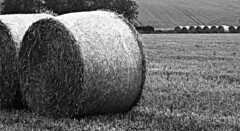
Giant circular bales which always look on the point of movement now dominate fields. They don’t move, I tried it once, even with the strength of ten pints it was not an easy task and not one recommended. Some fields still have a more traditional square bale, sometimes piled high, echoes of urban skylines, towers 16 bales high, 5 across leaning drunkenly dot the fields. The effort will have an efficient purpose, the size will be determined by some reasoning that eludes me. I can guess, but I don’t know. There is always something to learn.
Again this year I have failed to take a picture of the harvest that matches the one that is in my head, maybe next year.
So the farmers have danced with nature again and brought in the colourful crops for us. In the meanwhile the plants, left to their own devices have simply got on with it. Fruit has ripened, seeds are being distributed.
This has brought about another problem for walkers with dogs low to the ground and rough coated, seed heads. One walk was totally ruined by continually, and literally, having to cut thistle heads out of the dogs coats. In the end I had to carry them 3 miles. The accumulation of the heads had become too much, walking became impossible for them. The dogs coats were beginning to look moth eaten with my continuing ministrations. Cutting thistle heads out of wriggling dogs with a 1 inch pair of scissors does not make my top ten list of things to do.
This combined with the issues created by harvesting has meant field walking has been somewhat curtailed the last few weeks.
Before the seed head problem a recent walk took me past Langham Church. It was staging a wedding ceremony, so it did not seem like the appropriate time to go wandering in. Unfortunately for most churches, there is no longer a good time to wander in. The idea of the open church has long gone in many areas now. The population has retreated from church and the churches make themselves less approachable. The only church I have found open was no longer a church.
This was a great shame as Langham Church is reputed to have the oldest church chest in Essex. An oak dug-out dating from the 12th century. The venture to augment my walks with some fine historical church interiors is only going to be possible if I can solve the problem of the locked church.
The chest shown is from West Bergholt Old Church (the church that isn’t any longer) and dates from the 15th or 16th century. I am hoping to add to this image collection but the modern world may have put paid to that.
August was a month of small pilgrimage for me, the visit to the first Augustinian Priory in England. I did not capture the building that I saw, my snaps were workman-like, they are on flickr if you wish to see them.
The days are growing shorter now, noticeably so, sunsets are currently at the 20:00 mark, sunrise just before 06:00. Good news for the lazy photographer. No longer is there a need to get up desperately early to capture a sunrise and it is not so late that it affects the needs created by a working day. Likewise a sunset has been and gone and I am back home at an hour which means there is almost enough hours to sleep in.
August is a time of sunrise and sunset, the hint that autumnal colour is on its way and the next great season will soon be upon us. I am very much looking forward to this, even if the shorter days will start to impact on the available free time I have outdoors. I have my plans for September, if I am lucky half of it will get done.
Here is my collection of butterflies July – Aug 2009 that were slow enough to be photographed.
The idea of this was just to shift my focus somewhat from “what’s coming up next?” mentality. I considered a number of potential projects. Birds were just too Bill Oddie, I did not want that to happen to me. Birds also have a nasty habit of being brown and moving at high speed in the middle distance. My best hope is to try and identify the various alarm squawks emanating from them. It did not seem to fit what I was looking for at this juncture.
Flowers were a real possibility. I have tried it before, too much variety, too mind-boggling and rather too “girlie”. So they were ruled out. Tree identification was ruled out because it had the limiting factor there had to be trees and that was not always a possibility. Also the vast majority of them can be described as “brown and sticky” as per the schoolboy joke.
Flowers and trees had the significant advantage, they did not move, or at least had limited and fairly predictable patterns of movement.
Eventually though, butterflies, quintessential insects of warmth, were going to be in the frame.
Hopefully the days of huge collections of butterflies pinned to boards are over. My grandfather had plenty, dusty and broken, their brief lives brought to a premature end. It was a sad collection in so many ways. Physical evidence of a grandad’s youth falling apart behind glass. Time eats everything.
Photographing them is more of a challenge, the killing jar replaced by microchip. So many eluded me, many photographed were unfocused blurs. Others that did stick around and focused were brown blobs of considerable disinterest to anything but experts.
Some ruled themselves out by just being too small. This was a shame, but with my skillset the Skipper family looked like escapees from a roll of woodchip. It soon was obvious this was going to be about the strutting superstars that happened to float my way and pose.
This was the year of the Painted Lady.
It made headlines, a colourful invasion, every flower and hedge was carnival. Certainly the most beautiful and striking profusion they were ever present on walks. Now they are flying on faded wings, worn out from the sheer exuberance of flight. It is a melancholy sight too see them on dusty fading wings, youth gone. I have many pictures to remind me of their myriad beauty this year, this one is my favourite.
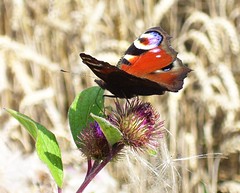
The Peacock butterfly is a true beauty and possibly the longest lived of UK butterflies. A potential lifespan of 11months, although 5 are spent in hibernation, seems possible.
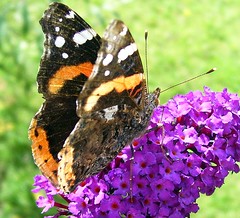
The Red Admiral is the defining butterfly of my youth. Everything largeish and reddish was a Red Admiral. This year though I found it rather tricky to find one, so I was pleased to see this fellow on my birthday. An interesting day for it to appear given its association with a youth I am now observing through the wrong end of the telescope.
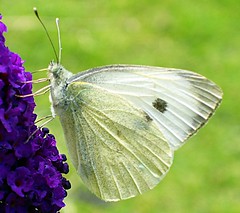
The large white cannot really be missed, strong fliers, they are everywhere. Probably more commonly known as cabbage white, a name they share with the small white. The larva like a bit of cabbage. Suits me if they ate every cabbage on earth, they seem to make much better use of them than we do.
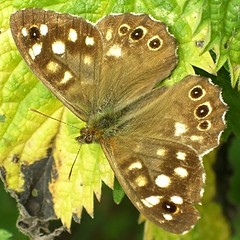
The Speckled Wood. Wonderfully marked, just a shame its so darn brown. Where there was one, there were many. Most certainly an insect of those shaded wooded areas.
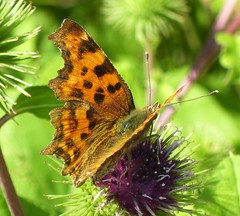
The Comma, a very distinctive butterfly with its ragged wing shape.
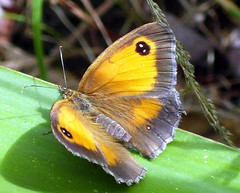
The Gatekeeper, a wonderfully colourful butterfly. I might have a tendency to muddle these with the Meadow Brown, they look quite similar with just a casual glance to me. Consequently not many of these have been seen, but a great many Meadow Brown’s have been seen. The distribution might not be as one sided as I imagine.
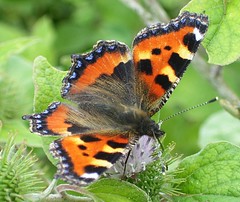
Tortoiseshell butterfly.
I had a real job getting a half decent picture of one of these. I did not see that many and those were too quick to capture. The markings are beautiful and that blue piping is so eye catching, it is wonderful.
Brown Argus.
I dont think it is the Common Blue, but its not easy to tell.
I have only seen these on a meadow near Fordstreet while walking The Essex Way this year. Very fortunate to get this picture as mostly they are too small and quick to get any sort of picture at all.
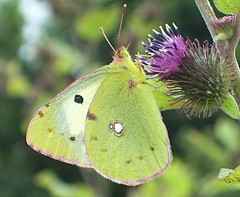
Clouded Yellow Helice Form.
I followed this butterfly for a quarter of a mile or so down the banks of the River Stour. When it first went past me I thought it was going to be a Brimstone and really wanted a photograph of it. As I got closer, there was a possibility of it being a Pale Clouded Yellow. These are very rare in England and would have been quite a find. Anyway after consultation with an expert on things butterfly assigning it as the Helice form seems the sensible thing to do.
I also have images of the Meadow Brown and the Ringlet, but these are poor images, but good enough for me to claim them.
Bush Tucker for me is exactly that, food found on a bush, or maybe stunted tree, easy reach material. I am not going to be bringing down any deer with a rifle or blasting bunny with a shotgun or well aimed stick.
Although I claim if necessary I’d strangle a pig with my bare hands to get hold of p0rk-chops, its an idle boast, the local butcher has nothing to fear.
As for fungi, I like the advice of one expert, “all fungi are edible, unfortunately some only once”
I let the food chains worry about those details, nothing is tasty enough to die for.
I like the idea you can stroll out into the woods and eat yourself to death. In an increasingly sanitized world this cannot be controlled. The chemist is no longer the place to blithely buy poison to kill of friends relatives and most of the village, or drug yourself up to the eyeballs, such luxuries went the way of the Victorians, but you can wander into the woods and collect the means of death and destruction, it looks like a mushroom, even tastes good.
I am not suggesting for one minute buying poison or narcotics from a chemist was a good idea, or that killing your relations with mushrooms is a legitimate plan. But it’s the same concept that allows cars to do more than 70mph despite the fact they are not allowed too. It is good to know the option is there, we have not all been reduced to barcodes in a governmental plan.
My autumnal project is photographing as many different fungi species as possible. They move less than butterflies so I am looking forward to this more relaxed pace. The downside being, this has the potential to be exceptionally geeky if not controlled. There might be over 1million forms of fungi yet to be recorded for example. Apparently there are 22,000 types in the UK. Most are brown and tediously tiny, nearly sub-atomic by the looks of them. So I am going to have to set suitable limits on this project to stop myself ending up staring at lumpy sticks through magnifying glasses and trying to pronounce Latin words longer than my arm.
Lets get back to the main track.
The only reason I watch Bear Grylls is to rock with laughter as he scoffs down some disgusting looking item which is wriggling. The only things he eats that looks worse is the stuff not wriggling.
Just lately other blogs have been waxing most lyrical on the lovely blackberries to be found. I don’t live in the Siberian wastelands so I could not wait to feast my eyes and tastebuds on this most child friendly of berries.
One of a number of things seems to have gone wrong. These succulent berries are a product of fevered minds or fisherman’s tales, is one possibility. The other is I simply have been rather unfortunate in having failed to find a decent batch, or finally berries aren’t what they used to be.
I am discounting the third option, global warming is to the environment what aspirin is to medicine. It’s the answer to everything but its damn boring hearing about how it cures all.
There might be some fevered minds out there in the outdoor world, but a conspiracy on this scale seems unlikely.
Frankly, its too early for blackberries, so I am not too concerned yet. But those red miserably hard looking berries are going to have to seriously improve. I did eat a few of the darker juicier variety but found maggoty wildlife had beaten me too most of them. This was much to close to a Grylls experience for my liking.
Other blackberries flattered to deceive, they looked the part but tasted foul.
I have hopes though, it was a grand year for strawberries. Wimbledon fortnight is always more enjoyable when watched with a large bowl of strawberries just picked from the garden. They taste great and even better when stacked up against the mad expense of the things on centre court. Strawberry jam will be enjoyed long into the year.
It was a bumper year for rabbits too, so the rest of the garden was eaten long before it reached my plate.
Earlier in the year I walked past a pea field, and I have to admit some sampling went on. Not on an industrial scale, a few pods were experimentally popped, untimely ripped, but peas can barely do wrong.
This looks to be a good year for sloes, they are everywhere. Described as eating a fruity deodorant stick, these astringent horrors I steer well clear of. These are in the theoretically edible category, along with my leather shoes.
I have spied some abandoned apples and pears on some walks, they have looked pretty meagre efforts but maybe the latest batch of weather will have done them good. I shall be keeping a keen eye on what goes on there.
Carrots are seen with their heads above the soil now, I resisted the urge to free them from earthy grasp. I admit it was because the farmers windows were very much in evidence. Cultivated crops are straying somewhat from the remit though. It is about like walking into someone’s kitchen raiding the fruit bowl and claiming to be living off the land. Maybe Bear G would consider this TV material, but not for me.
The real success this year in terms of wandering along footpaths have been cherry plums. The tastiest most juicy fruit hanging in large groups, often by quiet roadsides. Nobody seems to care about them. I make them feel loved and wanted. They are loved and wanted.
I saw an elderly woman collecting them in a churchyard to make jam with them to sell to the churchgoers. This seemed a time honoured traditional sort of thing. I fondly imagined the right to pick the berries having been handed down the female line of her family for multiple generations. Those generations, now feeding the tree on which the fruit comes, slumbering happily, tradition maintained. No doubt total nonsense but it enriches the inner landscape which, when it comes to the crunch, is all you actually have.
So I wait eagerly to see if blackberries are edible soon and on a longer term scale I noticed Sweet Chestnut trees heavy with prickly casings.
Last year was a miserable sweet chestnut year, even by the lowered expectations you need due to the English climate. They were small and spongy and overfilled with wriggling grubs, a lot of effort was expended for not a lot of eating. So I have my fingers crossed in that regard.